A Deep Dive into Clause 7 NCs

Welcome to the fourth instalment of our Most Common Non-Conformances (NCs) Insights Series. In this edition we will explore Clause 7: Support, which had almost the same number of NCs raised as Clause 8 across all three standards in our five-year review.
If you are new to this article series, we recommend going back and reading our previous articles listed below to understand the context better.
Support systems form the backbone of any effective management system. They provide the structure and support needed to keep everything aligned and functioning as intended, ensuring people, information and processes are working together seamlessly.
Clause 7 includes key elements that enable this; resources, competence, awareness, and documented information. While the structure of this clause is almost identical across all three standards (ISO 9001 Quality, ISO 14001 Environmental and ISO 45001 Safety), the intent varies depending on the focus of each standard.
Our five-year review showed that most NCs raised under this clause were related to documented information (subclause 7.5), highlighting ongoing challenges organisations face with controlling and maintaining documented information with actual practice. In addition, recurring issues were identified under resources (subclause 7.1), competence (subclause 7.2) and awareness (subclause 7.3).
Let’s look at each of these subclauses in further detail below.
Subclause 7.1 - Resources
Having the right resources in place is key to establishing and sustaining an effective management system. These resources include not only infrastructure and tools, but also clear processes, well-defined roles and responsibilities and easily accessible information.

In practice, organisations often have the necessary resources available, but more often than not, they are not clearly defined or effectively communicated. This is particularly common when they have multi-site operations where gaps in understanding and execution can lead to fragmented practices. When resources are not properly aligned organisations can open themselves to the risk of inconsistent service delivery and reduced system effectiveness.
Subclause 7.2 - Competence
Ensuring competence in your workers means they are appropriately trained as well as capable and confident in applying their knowledge and skills in day-to-day operations.

Too often, organisations treat competence as a one-time compliance driven activity, rather than a continuous cycle of development, assessment and improvement. Without structured evaluation and proper record-keeping, organisations can lose visibility on their workforce capabilities. Over time this can lead to gaps in organisational performance.
Subclause 7.3 - Awareness
Awareness connects employees to the management system, ensuring they understand both its purpose and their individual responsibilities. It helps them understand not just what is needed, but also why it matters.

Worker awareness usually starts in induction, but must be continuously reinforced through communication and everyday practices. When awareness is lacking, even well-documented systems can become disconnected from daily operations, as employees are unable to fully engage with them and contribute to the systems’ success.
Subclause 7.5 - Documented Information
Documented information serves as the blueprint of any management system, outlining processes and providing evidence of their implementation. And yet despite its importance, this subclause remains frequently misunderstood.
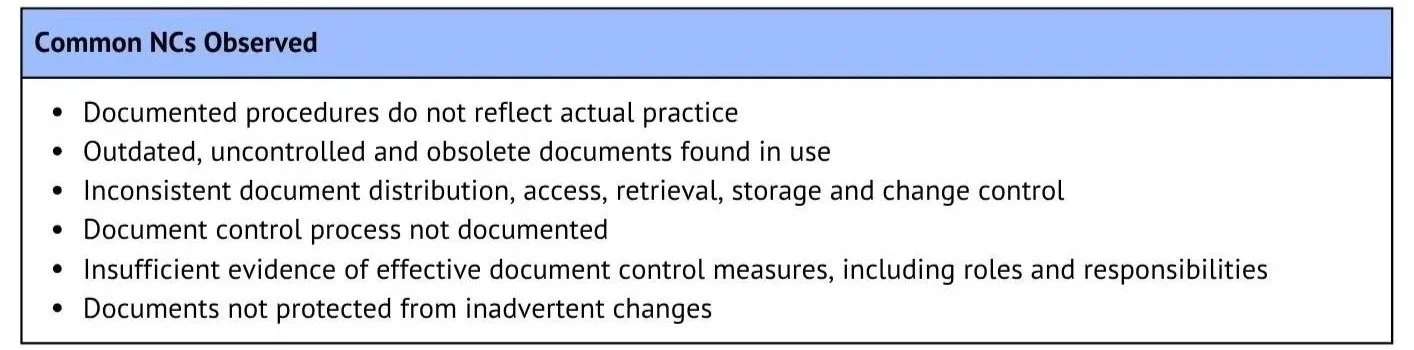
Documentation only adds value when it’s accurate and controlled, reflecting what happens in actual practice. In many instances organisations maintain an extensive database of documentation, but most of it is not actively managed. Over time these documents become outdated, misaligned or inconsistently applied, creating a disconnect between documented procedures and real- world practices.
Key Takeaway
A recurring theme across Clause 7 NCs is that while organisations establish the foundations of their support systems, they often struggle to maintain them with discipline, consistency and visibility.
Resources, competence, awareness and documented information must work together as an integrated support structure, not as isolated components. When one element is weak, it can impact the effectiveness of the entire system. Without ongoing attention and alignment, even well-designed management systems can risk becoming disconnected from day-to-day operations.
What’s Next?
In our final instalment, we will explore the final set of common NCs across clauses 4, 5, 6 and 10.
Thinking of Getting Certified?
Certex is accredited with the Joint Accreditation System of Australia and New Zealand (JASANZ) quality, safety and environmental standards. When you are prepared to take the next steps in your certification journey, reach out to us via phone or email to see how we can support you.
Stay tuned for Article 5, where we dive deep into the final set of NCs.