
Clause 9: The Most Common Stumbling Block

Welcome to the first instalment of our Most Common Non-Conformances (NCs) Insights Series. In this instalment we will explore the clause that generated the highest number of NCs across all three standards in our five-year review; Clause 9 - Performance Evaluation. If you are new to this article series, we recommend going back to our introductory article to understand this context better.
Performance Evaluation is the cornerstone of any management system. It provides organisations with a mechanism to identify improvement opportunities and evaluate whether their management system is operating as it should be, whether it is meeting its objectives and if there is alignment between planned processes and actual performance.
During our review, it was observed that the majority of NCs raised under Clause 9 were linked to internal audits (subclause 9.2), across all three standards. It also highlighted recurring issues raised in monitoring, measurement, analysis and evaluation (subclause 9.1) and management reviews (subclause 9.3).
Let’s look at NCs raised in each of these subclauses in further details below.
Subclause 9.1 - Monitoring, Measurement, Analysis and Evaluation
Essential insights into system performance and compliance can be gathered through proper monitoring, measurement, analysis and evaluation. Yet our analysis showed frequent gaps appearing in these processes.
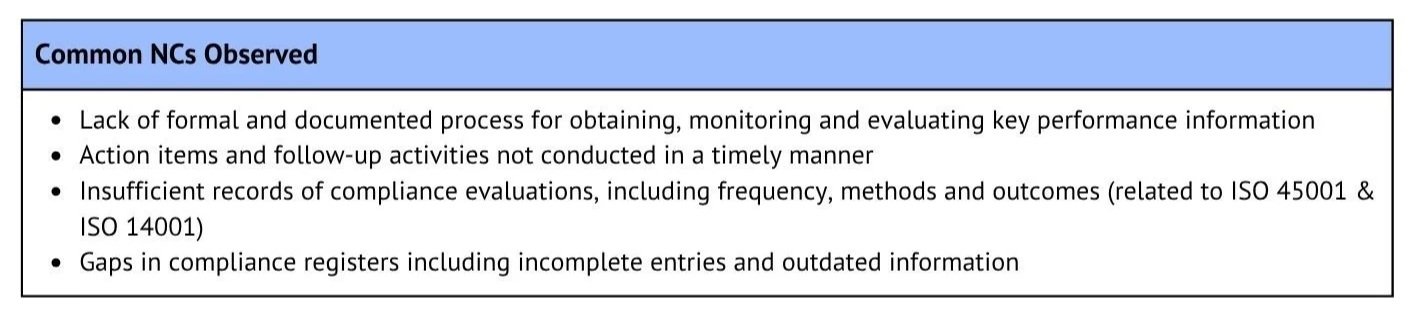
Monitoring and analysis can be applied to a wide range of inputs such as operating data, performance metrics and customer feedback. In simple, it can be applied to anything that can provide insights into how well the organisation is performing. When used properly, information gathered can be highly valuable in terms of identifying trends and anomalies and support informed decision making.
Subclause 9.2 - Internal Audits
Internal audits remain one of the most important tools organisations can use to verify if their management systems are working as they should be, yet it’s often one of the most mishandled. Many organisations end up treating internal audits as a tick box exercise rather than an opportunity for improvement.
Across our review, internal audits appeared to be the subclause with the greatest number of NCs.
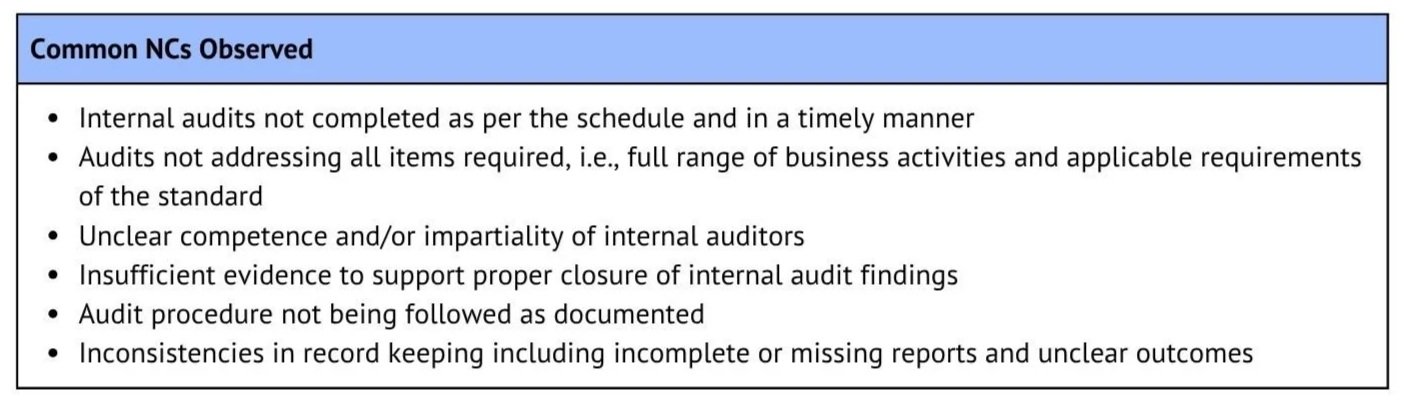
Most often an ineffective audit program is the result of limited understanding on how internal audits should be planned and conducted. Without clear purpose and structure, organisations often tie themselves in knots trying to conduct internal audits, spending numerous hours and creating confusion among staff. Well-planned audits, supported by appropriate training often deliver the best outcomes. If you are unsure on how to conduct internal audits, the best course of action is to get the appropriate training first.
Subclause 9.3 - Management Review
Management reviews are essential for an organisation to maintain strategic oversight of its management system and for evaluation of performance at the leadership level.
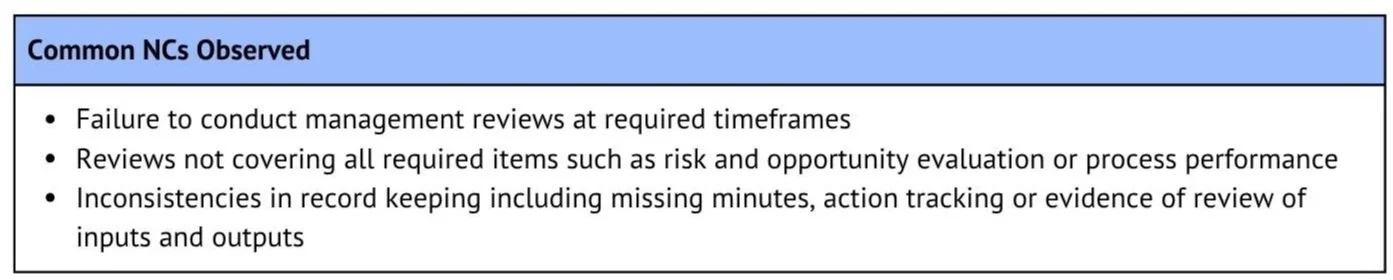
When managers are focused on working in the business instead of working on the business, opportunities for strategic reviews are often missed. Regular and structured management reviews can help organisations to step back from reactive decision making and focus on how well the business and the management systems that are supporting it are performing.
Key Takeaway
A recurring theme across all Clause 9 NCs is “inconsistency.” It shows that most of these NCs have not been raised due to lack of effort but due to gaps in timing, evidence, scope and follow-throughs.
What’s Next?
In our next month's instalment we will explore Clause 8: Operations, where NCs arise when there are gaps between documented processes and application in the real world.
Thinking of Getting Certified?
Certex is accredited with the Joint Accreditation System of Australia and New Zealand (JASANZ) quality, safety and environmental standards. When you are prepared to take the next steps in your certification journey, reach out to us via phone or email to see how we can support you.
Stay tuned for Article 3, where we dive deep into Clause 8: Operations.