The Final Set of Common NCs Across Clauses 6, 4, 5 and 10

Welcome to the fifth and final instalment of our Most Common Non-Conformances (NCs) Insights Series. In this edition we will explore the final set of common NCs raised across clauses 6, 4, 5 & 10 across all three standards in our five-year review.
If you are new to this article series, we recommend going back and reading our previous articles listed below to understand the context better.
While clauses 7, 8 and 9 recorded the highest number of NCs overall, findings across these remaining clauses pointed to something more fundamental. It showed gaps in how organisations set direction, align their systems and manage the performance of their management systems over time.
Let’s take a closer look at each of these clauses below.
Clause 6 - Planning
Among the clauses discussed here, Clause 6 had the most number of NCs. At its core, planning brings structure to uncertainty by defining risks & opportunities, setting objectives and managing change. While the concept is consistent across all three standards, how it is applied depends on the purpose of the management system of each standard.
Subclause 6.2 - objectives and planning to achieve them is the most commonly misunderstood, however a significant number of NCS have also appeared under the subclauses;
6.1 (Quality) - Actions to address risks & opportunities
6.1 (Safety) - Hazard identification, OH&S risks & OH&S opportunities
6.1 (Environmental) - Environmental aspects, compliance obligations, risks & opportunities
6.3 (Quality) - Planning for change
Clause 6.1 (Quality) - Actions to Address Risks & Opportunities
Integrating a risk-based thinking approach is essential for effective planning, yet most organisations continue to face challenges in practising it consistently.

In most instances, organisations identify and document their risks, but they fail to consistently carry them into planning or maintain them over time. This creates a silent gap where risk registers exist, but they are not always current and are not always referred to when making decisions. As a result, organisations may be exposed to compliance issues and operational uncertainty often without realising it.
Clause 6.1 (Safety) - Hazard Identification, OH&S Risks, OH&S Opportunities, Compliance Obligations & Clause 6.1 (Environmental) - Environmental Aspects, Compliance Obligations, Risks & Opportunities
Maintaining updated and effective processes for managing legislative and risk requirements is also an area most organisations continue to face challenges across both safety and environmental systems.

In many instances, while organisations have the proper systems in place, they struggle to keep them current. Without regular reviews and updates, gaps can emerge between regulatory or operational changes and existing processes. These gaps can quickly turn into compliance risks.
Clause 6.2 - Objectives and Planning to Achieve Them
Objectives are intended to drive performance and provide measurable and clear direction. However, turning intent into meaningful outcomes continues to be a common challenge.
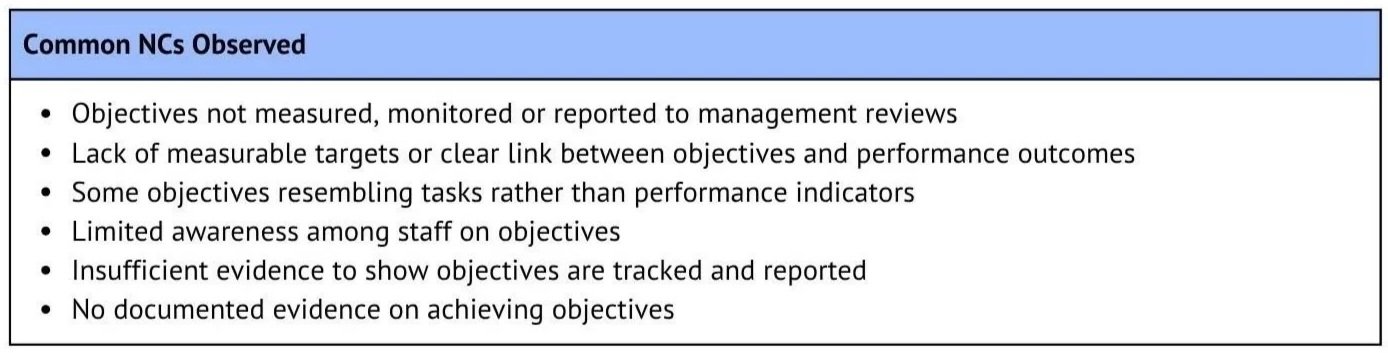
While every organisation has set objectives, often they have a disconnect between what is documented and what is measured or tracked in practice. Without proper visibility and measurement, objectives can lose their purpose. They stop being drivers of performance and instead turn into static statements with little practical impact.
Clause 6.3 (Quality) - Planning for Changes
Change is inevitable within any organisation, but without proper control and documentation it can create inconsistencies within the management system.
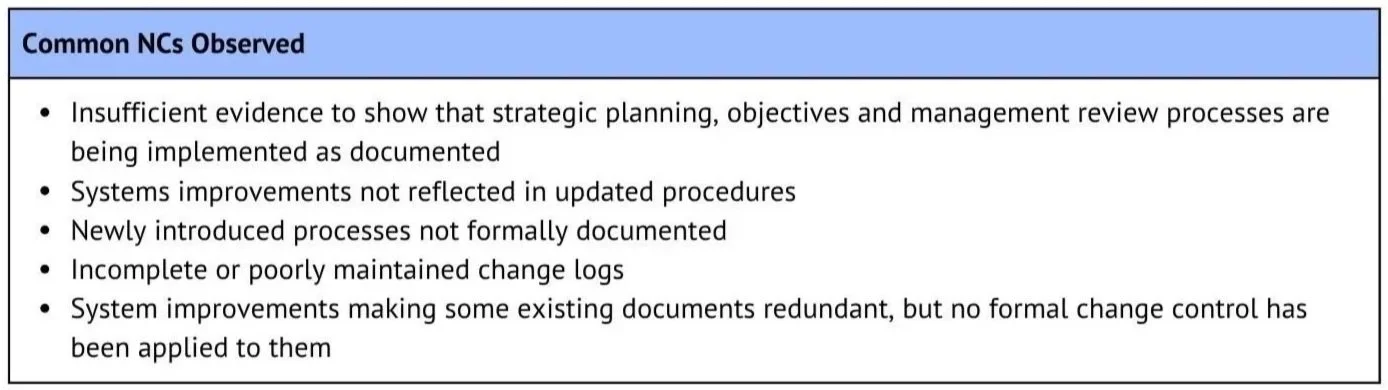
When change is not properly managed, management systems might appear right on paper but will tell a different story in reality. Over time, this gap can weaken confidence in the system as documentation no longer reflects actual practice.
Clause 4 - Context of the Organisation
The foundation of the management system is set within clause 4 by ensuring organisations clearly understand their internal and external environment. In simple, it asks whether the organisation truly understands the environment that they operate in and what is expected of them.

Without a clear and traceable understanding of context, it becomes harder for organisations to ensure that their management systems remain relevant and aligned with real-world conditions of the environment that they operate in.
Clause 5 – Leadership
Leadership plays an important role in setting the direction, establishing accountability and ensuring that the management system is embedded in the everyday operations of the organisation.

When leadership structures are not clearly communicated or maintained, it can create confusion, slow down decision making and reduce overall accountability and weaken the management system.
Clause 10 – Improvement
The long-term success of a management system depends on continuous improvement. However, improvement only works when it is visible, tracked and followed through.

Without structured improvement processes, organisations risk revisiting the same issues again and again without truly moving forward.
Key Takeaway
A recurring theme across Clauses 4, 5, 6 and 10 is that while organisations often establish strong management systems, they face challenges in maintaining them with consistency, visibility and discipline.
Planning, leadership, context and improvement are deeply interconnected within management systems, and when one starts to drift, others can follow. But when they are aligned, they can form a strong framework that supports long-term system maturity and performance.
Thank You for Following Our Series
This concludes our Most Common Non-Conformance Insights Series.
We hope these insights have provided valuable visibility into the most frequently observed NCs across ISO 9001, ISO 14001 and ISO 45001. While every organisation is unique, recurring patterns across the market offer a useful perspective on the common challenges associated with certification and system maintenance.
Thinking of Getting Certified?
Certex is accredited with the Joint Accreditation System of Australia and New Zealand (JASANZ) quality, safety and environmental standards. When you are prepared to take the next steps in your certification journey, reach out to us via phone or email to see how we can support you.