Clause 8: Key Operational NC Trends

Welcome to another instalment of our Most Common Non-Conformances (NCs) Insights Series. In this edition we will explore Clause 8: Operational Controls, which had the second highest number of NCs across all three standards in our five-year review.
If you are new to this article series, we recommend going back and reading our previous articles listed below to understand the context better.
Operational Controls form the engine room of any management system. This is where the management system of an organisation is tested in operation. Our analysis showed that the most NCs raised within this clause related to control of externally provided processes, products and services (subclause 8.4).
Following closely behind are operational planning and control (subclause 8.1), requirements for products and services (subclause 8.2 Quality) and emergency preparedness and response (also subclause 8.2 across the ISO 14001 Environmental and ISO 45001 Safety standards).
Let’s look at the NCs raised within each of these subclauses in further detail below.
Subclause 8.1 - Operational Planning and Control
Operational planning is key in setting the foundation for a consistent and controlled process. Yet our review highlighted frequent gaps between documented procedures and their practical implementation.
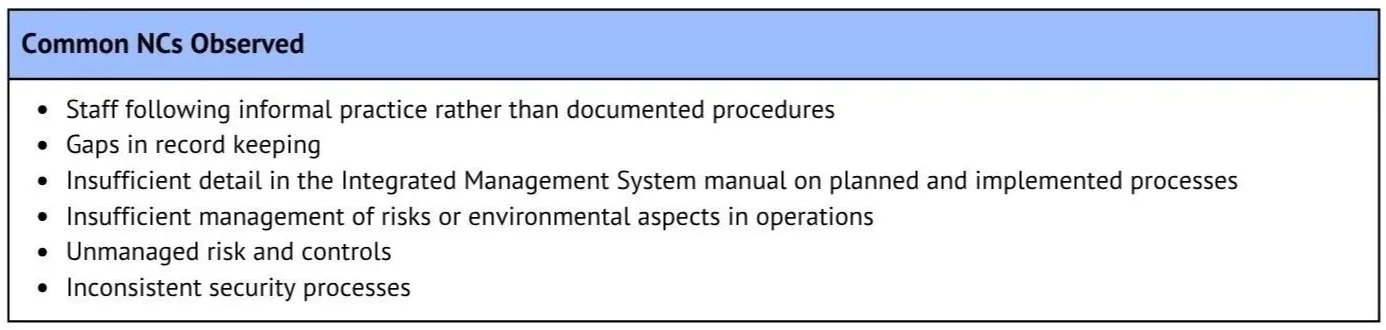
When procedures are written purely for compliance without taking into consideration their practical implementation, staff often revert to processes that feel easier or quicker. Effective operational planning and controls must be clear, accessible, and easily embedded into how work is actually done.
Subclause 8.2 (Quality) - Requirements for Products and Services
Under the ISO 9001 Quality Management Standard, subclause 8.2 relates to understanding and meeting customer requirements. NCs within this clause highlight challenges organisations face when translating customer needs into defined, traceable requirements and actions.

When organisations rely on informal communications or assumptions around customer expectations, they open themselves to the risk of delivering services that do not meet customer requirements. Clear documentation and review processes are essential to ensure customer satisfaction.
Subclause 8.2 (Safety & Environmental) - Emergency Preparedness and Response
Under the ISO 45001 Safety Management Standard and the ISO 14001 Environmental Management Standard, subclause 8.2 relates to emergency readiness to control unforeseen events and emergencies. A most common observation within this is that emergency controls exist mostly as theoretical plans rather than practical and tested arrangements.

Emergency plans that are not tested in practice over time become obsolete quickly. Regular training, updates and testing are essential to ensure they remain current as well as to ensure staff is equipped to respond effectively in the case of an incident.
Subclause 8.4 - Control of Externally Provided Processes, Products and Services
Managing supplier, contractor and outsourced activities is the most common operational challenge across all standards. Our auditors have often identified that while most organisations have supplier controls in principle, they are often not proportionate to the risks or applied consistently.
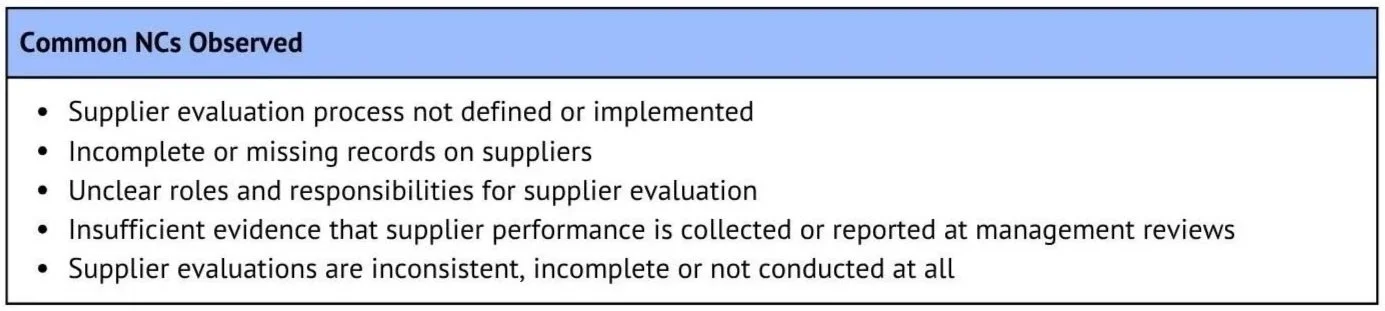
More often than not, organisations underestimate the influence suppliers and contractors can have over their quality, safety and environmental outcomes. Effective supplier and contractor controls require ongoing monitoring, meaning evaluation and management oversight, rather than being a one-time approval exercise.
Key Takeaway
A recurring theme across Clause 8 NCs is the tendency of organisations to focus on compliance rather than control. Procedures exist, but consistent application, monitoring and reviewing is where most organisations fall behind.
What’s Next?
In our next month's instalment, we will explore Clause 7: Support, which examines the people, competence, awareness, communication and resources an organisation needs to operate an effective management system.
Thinking of Getting Certified?
Certex is accredited with the Joint Accreditation System of Australia and New Zealand (JASANZ) quality, safety and environmental standards. When you are prepared to take the next steps in your certification journey, reach out to us via phone or email to see how we can support you.
Stay tuned for Article 4, where we dive deep into Clause 7: Support